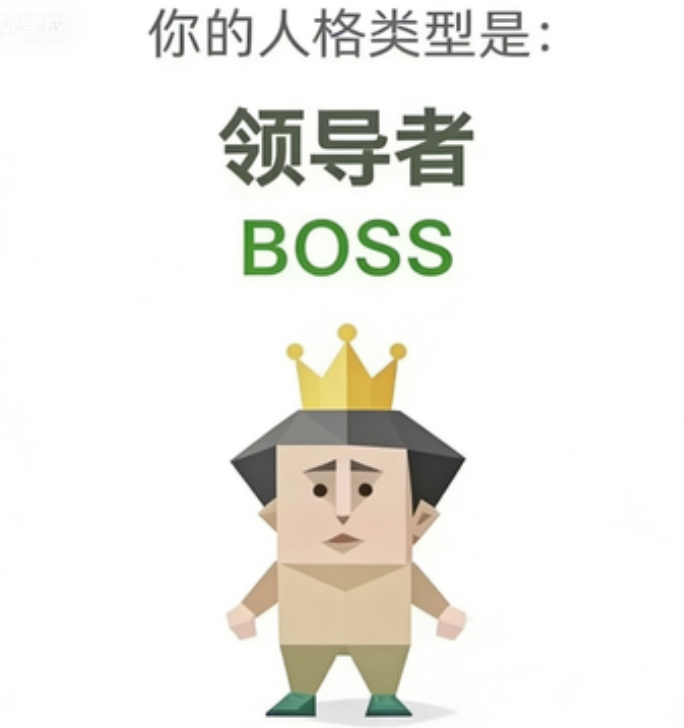
BOSS Main-Character Manager
You want the steering wheel even when the car is on fire.
What does BOSS mean in SBTI?
BOSS in SBTI is not about being an actual CEO or manager. It is a chaos personality label that captures the energy of someone who compulsively takes charge even when nobody asked them to. The BOSS type got its name because the result caption reads like a command: "Give me the steering wheel, I will drive, and then we all crash together."
In the SBTI framework, BOSS emerges from a specific combination across fifteen playful dimensions. It is not a clinical diagnosis. It is a meme-ready label that describes a very recognizable social archetype: the person who plans the group trip, assigns roles in the group chat, and then panics when the plan falls apart.
The BOSS type is one of the most commonly shared SBTI results on social platforms. People who get BOSS usually react with a mix of pride and self-roasting. They know they are controlling. They also know it is funny.
BOSS personality traits
Natural leadership instincts. BOSS types step up by default. When a group is drifting, they assign tasks. When a conversation is circular, they summarize action items. They do not wait for permission to organize.
High accountability, low delegation. A classic BOSS paradox: they demand control but struggle to trust others with execution. They would rather do everything themselves than watch someone else do it wrong.
Anxiety disguised as efficiency. Underneath the take-charge exterior, many BOSS types are managing underlying anxiety about chaos. Organizing things is their coping mechanism. The spreadsheet is a security blanket.
Conflict between vision and reality. BOSS types often have a clear mental picture of how things should go. When reality deviates, they experience disproportionate frustration. This is the "crash" part of the steering wheel metaphor.
Meme literacy and self-awareness. Most BOSS types who share their results online do so with a layer of irony. They know the label is exaggerated. That is the point.
BOSS in relationships
In friendships, BOSS types are the group admin. They create the group chat, set the meetup location, and send reminder messages. Their friends secretly appreciate this while occasionally finding it exhausting.
In romantic relationships, BOSS types can be protective and proactive partners. They remember anniversaries, book reservations, and plan weekends. The risk is that they may treat their partner like a project manager treats a task list, which can feel impersonal.
When two BOSS types date, the dynamic is either a power couple or a constant negotiation over who is in charge. It rarely stays neutral.
BOSS at work / school
BOSS types thrive in environments where structure is valued. They make excellent project coordinators, team leads, and operations managers. They are the ones who create the shared document before the meeting even starts.
In school, BOSS types are often the group project leaders by default. They may complain about carrying the team, but they also refuse to let anyone else lead.
The career risk for BOSS types is burnout from over-management. They need to learn that not every process needs optimization, and not every teammate needs supervision.
BOSS under stress
When stressed, BOSS types double down on control. They make more lists, send more follow-up messages, and attempt to micromanage situations that cannot be managed. The steering wheel metaphor becomes literal: they keep gripping tighter even as the car spins.
The healthy response is to recognize when control is an illusion and redirect that energy into something productive, like exercise or creative work.
BOSS vs MBTI types
BOSS does not map cleanly to any single MBTI type, but there are patterns:
- ENTJ: The natural overlap. Strategic, commanding, goal-oriented.
- ESTJ: Similar organizational drive, more tradition-bound.
- ENFJ: Charismatic leadership, more people-focused than process-focused.
- INTJ: Quiet control, prefers planning to direct management.
- INFP: Surprising BOSS candidates. Some INFPs develop controlling tendencies as a defense against internal chaos.
Best & worst SBTI matches for BOSS
Best matches
OJBK (The "Whatever" Person): OJBK types do not challenge BOSS authority. They go with the flow. This creates a stable dynamic where BOSS plans and OJBK executes without friction.
THAN-K (The Grateful One): Appreciates BOSS organization and rarely pushes back.
GOGO (The Walker): Shares the proactive energy but without the control impulse.
Worst matches
CTRL (The Controller): Two controllers in one room is a management crisis. Both want the steering wheel. Neither will let go.
DEAD (The Dead Inside): BOSS wants action. DEAD wants to lie down. These energies repel each other.
FAKE (The Fake): BOSS values authenticity and directness. FAKE operates through performance. Misunderstanding is inevitable.
Shareable BOSS result captions
- "I got BOSS on SBTI. Translation: I will take charge of your life without asking."
- "BOSS energy is wanting the steering wheel even when the car is on fire."
- "My SBTI type is BOSS. My therapist says I have control issues. I say I have leadership skills."
- "You do not need a manager if you have a BOSS friend. You also do not need peace."
- "BOSS + OJBK friendship: one plans, the other agrees. It is the most functional relationship I have."
FAQ
No type is bad. BOSS is one of the most socially functional types. The label pokes fun at control tendencies, not condemns them.
ENTJ and ESTJ are the most common, but any type can get BOSS depending on their answers to the fifteen dimensions.
SBTI results reflect momentary patterns. A stressed BOSS might test as DEAD or IMFW during a difficult period.
It sounds impressive while also being self-deprecating. People love labels that let them brag and roast themselves at the same time.
Take the SBTI test
Want to find your own SBTI type? Take the free 31-question test and discover which of the 27 chaos personality types matches you.
Take the SBTI test