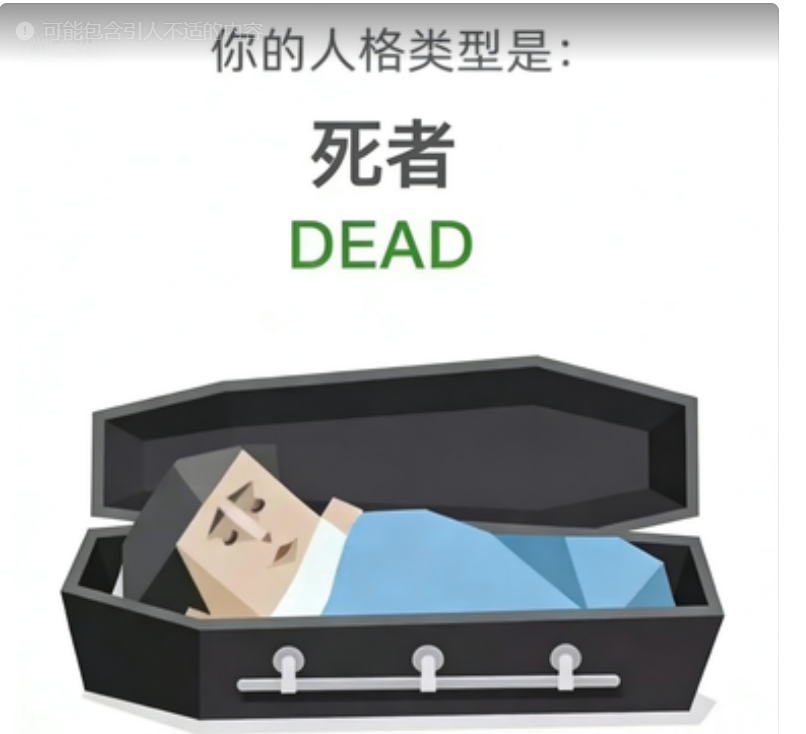
The Dead Inside
Physical death has not occurred, but social death is complete.
What does DEAD mean in SBTI?
DEAD in SBTI does not mean clinically depressed or actually deceased. It is a chaos personality label that captures the feeling of being emotionally flat, socially withdrawn, and existentially tired. The DEAD result caption reads: "Physical death has not occurred, but social death is complete."
DEAD is one of the most resonant SBTI types because it names a feeling that many people experience but struggle to articulate. It is the mood of wanting to respond to a group chat but deciding it is not worth the energy. It is the realization that you have not left your room in two days and you are not particularly bothered by it.
In the SBTI framework, DEAD emerges from low scores on social energy, emotional expression, and proactive engagement. It is not a medical label. It is a meme that says "I am too tired for this" in a way that makes people laugh and tag their friends.
DEAD personality traits
Emotional flatness as a default state
DEAD types do not necessarily feel sad. They feel nothing, or they feel everything so intensely that their brain shuts down and returns a 404 error. The flatness is a defense mechanism.
Social energy bankruptcy
Interacting with people costs more energy than it provides. DEAD types can perform social roles when required, but the battery drains fast and takes days to recharge.
Dark humor as primary coping mechanism
DEAD types are often the funniest people in a friend group because their humor comes from a place of genuine absurdity. They see the ridiculousness in trying to be a functional adult.
Selective engagement
When DEAD types do care about something, they care deeply. The trick is finding the thing that breaks through the fog. It might be a specific person, a creative project, or a hyperfixation.
High observational intelligence
Because DEAD types are often on the sidelines, they notice things others miss. They are the ones who remember what everyone said at the party because they were not really participating.
DEAD in relationships
In friendships, DEAD types are the quiet observer. They may not initiate plans, but they will show up for the people who matter. Their loyalty is deep but invisible. You do not notice it until they are not there.
In romantic relationships, DEAD types need partners who understand that absence of expression is not absence of feeling. They show love through consistency rather than grand gestures. A DEAD type who texts you every day is performing an emotional marathon.
When two DEAD types date, the relationship can be incredibly peaceful or dangerously stagnant. There is no drama, but there is also sometimes no momentum.
DEAD at work / school
DEAD types excel in roles that reward deep focus over social performance. Research, writing, coding, and design are natural fits. They do not want to attend three meetings to discuss one decision.
In school, DEAD types may underperform in group projects but overperform in independent assignments. They are the ones who write the entire essay at 3 AM because that is when their brain decides to work.
The career challenge for DEAD types is finding environments that value output over visibility. Open office plans and mandatory fun events are their natural enemies.
DEAD under stress
Under stress, DEAD types do not panic. They shut down. They cancel plans, stop responding to messages, and retreat into low-stimulation environments. This is not laziness. It is emotional damage control.
Recovery requires time, low expectations, and usually a very specific comfort activity that makes no sense to anyone else.
DEAD vs MBTI types
- INFP: Common overlap. Rich inner world, socially selective, emotionally intense.
- INTP: Similar withdrawal patterns, more analytical than emotional.
- INFJ: Surprising DEAD candidates. Their empathy burns them out.
- ISTJ: Quiet and reserved, but more functional than DEAD typically implies.
- ISFP: Artistic withdrawal, more sensory than existential.
Best & worst SBTI matches
Best matches
- HHHH (The Ha-Ha Person): HHHH brings light energy without demanding emotional labor. They laugh at the darkness instead of trying to fix it.
- MONK (The Monk): Shares the withdrawn energy but adds a philosophical framework. Two people sitting in silence, content.
- OJBK (The "Whatever" Person): Low maintenance, no pressure, peaceful coexistence.
Worst matches
- BOSS (The Main-Character Manager): BOSS wants action. DEAD wants to lie down. BOSS interprets DEAD as a problem to solve.
- GOGO (The Walker): GOGO's proactive energy feels like an accusation to DEAD.
- LOVE-R (The Chaos Romantic): LOVE-R wants emotional intensity. DEAD has intensity but cannot express it on demand.
Shareable DEAD result captions
- "I got DEAD on SBTI and honestly this is not a personality type, this is a life status."
- "Physical death has not occurred. Social death is complete. Mood: DEAD."
- "My SBTI type is DEAD. My therapist says I should socialize more. I say my SBTI type is DEAD."
- "DEAD + HHHH friendship: one provides the darkness, one provides the laughter. It is a balanced ecosystem."
- "MBTI tells you who you are. SBTI tells you why your group chat is worried about you. DEAD edition."
FAQ
Is DEAD a depressing SBTI type?
It names a real emotional state, but it frames it with humor. Many DEAD types find the label validating rather than depressing.
Can DEAD types be happy?
Absolutely. DEAD describes energy patterns, not happiness levels. Many DEAD types are content in their low-energy state.
What should I do if my friend got DEAD?
Do not try to fix them. Invite them to things without pressure. Sometimes the best support is a text that says "You do not have to respond to this."
Why is DEAD so popular on social media?
It captures a generational mood. The combination of exhaustion and irony resonates deeply with young adults online.
Take the SBTI test
Want to find your own SBTI type? Take the free 31-question test and discover which of the 27 chaos personality types matches you.
Take the SBTI test