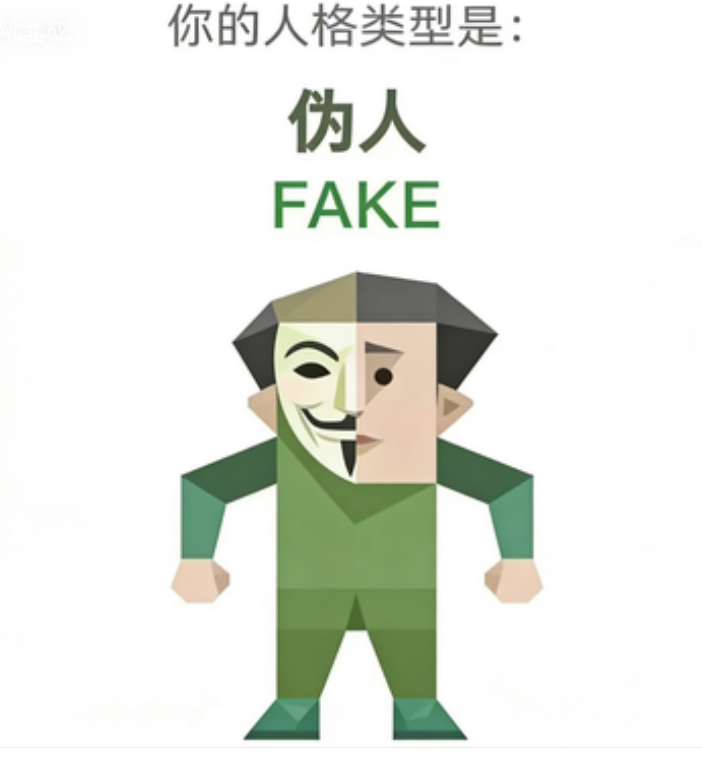
FAKE The Performer
Smiling on the outside, still smiling on the inside, because fake people do not have hearts.
What does FAKE mean in SBTI?
FAKE in SBTI is the "Impostor" or "Performer" type. It captures the energy of someone who feels like they are playing a role in their own life, wearing a mask that has been on so long they are not sure what is underneath anymore. The FAKE result caption reads: "Smiling on the outside, still smiling on the inside, because fake people do not have hearts."
FAKE is not about being dishonest in a malicious way. It is about the exhaustion of performing a self that feels expected rather than authentic. FAKE types are often highly socially skilled, adaptable, and perceptive. They are also often lonely in a specific way that comes from never being seen.
In the SBTI framework, FAKE emerges from high social awareness, low self-congruence, and adaptive presentation. It is the type who can read a room in seconds and become exactly what that room needs.
FAKE personality traits
Chameleon-like social adaptation
FAKE types adjust their personality to fit the context. They are not being manipulative. They are being appropriate. The problem is that after enough adjustments, the original settings file is corrupted.
Performance as default mode
Around others, FAKE types are "on." They match energy, mirror values, and anticipate expectations. Alone, they may feel empty because the performance requires an audience, and without one, there is no script.
Deep self-awareness, shallow self-connection
FAKE types often understand themselves very well. They know what they are doing, why they are doing it, and how it affects others. The gap is between knowing and feeling. They can describe their authentic self but struggle to access it.
Fear of being truly known
If someone sees the real FAKE type, the performance ends. And if the performance ends, what is left? This fear keeps the mask on even with people who would accept what is underneath.
Surprising authenticity in specific contexts
FAKE types often have one or two spaces where the mask comes off. Usually it is with a specific person, during a specific activity, or in a specific environment. These moments are rare and precious.
FAKE in relationships
In friendships, FAKE types are the friend who is always fine, always agreeable, always appropriate. They remember birthdays, give good advice, and never burden anyone with their problems. Their friends love them but may not know them.
In romantic relationships, FAKE types can be attentive, accommodating partners. They are good at being what their partner needs. The challenge is learning to need something themselves and to ask for it.
When two FAKE types date, the relationship is two performances negotiating a shared script. It can work if both decide to drop the act, but that requires vulnerability neither has practiced.
FAKE at work / school
FAKE types excel in roles that require social intelligence, adaptability, and reading people. Sales, consulting, acting, diplomacy, and any client-facing role suits them. They are the ones who can handle difficult personalities because they become what those personalities need.
In school, FAKE types may be the students who are well-liked by teachers, popular with peers, and internally exhausted. They are on student council, in the right clubs, and wondering when they get to stop performing.
The career risk for FAKE types is burnout from sustained inauthenticity. They need to find roles or environments where their natural self is also their professional self.
FAKE under stress
Under stress, FAKE types perform harder. They become more agreeable, more accommodating, more perfectly appropriate. The mask gets thicker. The distance between self and performance gets wider.
Recovery requires a safe space where performance is not required. A person, a place, or an activity where the mask can come off without consequence.
FAKE vs MBTI types
- ENFJ: Natural overlap. Socially skilled, adaptable, people-focused.
- ESFJ: Similar social performance, more tradition-bound.
- ENTP: Social chameleon, more intellectually than emotionally adaptive.
- ISFP: Surprising FAKE candidate. Their authenticity is private; their public self is performative.
- INFJ: Insightful performance, often feels misunderstood despite social competence.
Best & worst SBTI matches
Best matches
- DEAD (The Dead Inside): DEAD does not need performance. They do not need anything. This creates space for FAKE to rest.
- OJBK (The "Whatever" Person): Low expectations mean low performance pressure.
- MONK (The Monk): MONK's non-judgment creates a rare safe space.
Worst matches
- BOSS (The Main-Character Manager): BOSS values directness. FAKE's adaptability reads as inauthenticity.
- CTRL (The Controller): CTRL wants predictability. FAKE is inherently unpredictable because they change based on context.
- IMSB (The Self-Attacker): IMSB's self-criticism triggers FAKE's fear of being exposed.
Shareable FAKE result captions
- "I got FAKE on SBTI. I am not fake. I am just socially adaptable to the point of losing myself."
- "FAKE energy: being the most liked person in the room and the loneliest person in the Uber home."
- "My SBTI type is FAKE. I have three different personalities and none of them are mine."
- "FAKE + DEAD friendship: one performs, one does not care. It is the most restful relationship I have."
- "MBTI tells you how you interact. SBTI tells you why you feel empty after a great night out. FAKE edition."
FAQ
Is FAKE about being a liar?
No. FAKE describes a pattern of social adaptation that can lead to inauthenticity. It is not about deception. It is about performance exhaustion.
Can FAKE types be authentic?
Absolutely. Many FAKE types are deeply authentic in specific contexts. The work is expanding those contexts.
Should I worry if my friend got FAKE?
Use it as an invitation to create space where they do not need to perform. Be the person who sees them, not the person who needs them.
Why is FAKE relatable to so many people?
Because modern social life requires performance. Social media, workplace culture, and social expectations all reward adaptation. FAKE names the cost.
Take the SBTI test
Want to find your own SBTI type? Take the free 31-question test and discover which of the 27 chaos personality types matches you.
Take the SBTI test