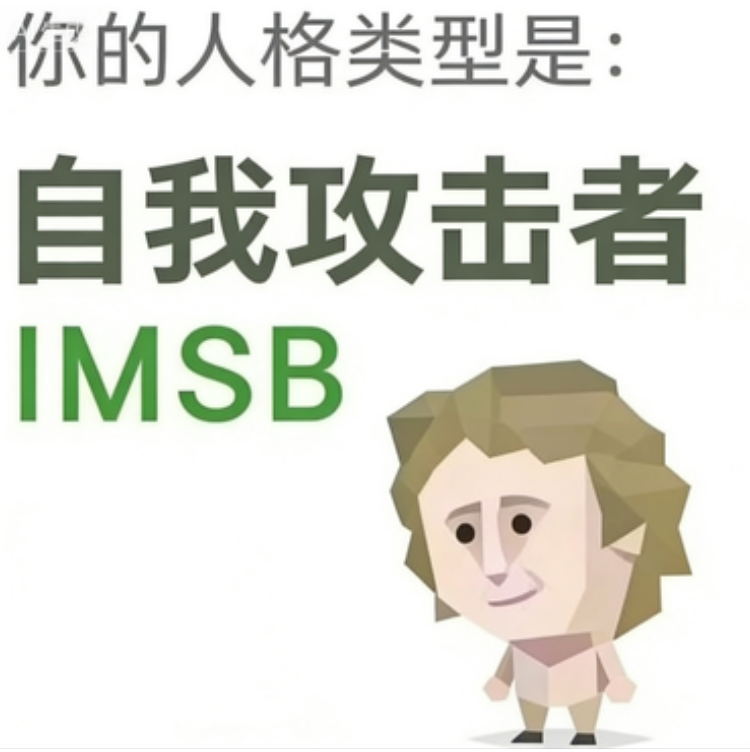
IMSB Self-Attacker
Every day I deny myself, but I never stop attacking myself.
What does IMSB mean in SBTI?
IMSB stands for "I am so bad" or "I am such a burden" depending on how you read it. In SBTI, it is a chaos personality label that captures the energy of relentless self-criticism, imposter syndrome, and the compulsive need to apologize for existing.
The IMSB result caption reads: "Every day I deny myself, but I never stop attacking myself." It is not a clinical diagnosis of low self-esteem. It is a meme that says "I am my own worst enemy" in a way that makes people laugh because it is too real.
IMSB types are often high-functioning individuals who appear confident externally while running a continuous negative commentary internally. They are the friend who says "sorry" when someone else bumps into them.
IMSB personality traits
Internal criticism as background noise
IMSB types do not experience silence. Their inner monologue is a perpetual performance review, and the reviewer is never satisfied. Every conversation is mentally replayed with alternate, better responses.
Over-apologizing reflex
"Sorry" is punctuation, not an apology. IMSB types apologize for taking up space, for having opinions, for needing things. They apologize for apologizing too much.
Imposter syndrome regardless of evidence
Accomplishments feel like accidents. Praise feels like a setup. IMSB types can win awards and still believe they fooled everyone. The thought process is not "I earned this" but "They have not figured me out yet."
High empathy, misdirected
IMSB types are often deeply attuned to other people's feelings. They notice micro-expressions, tone shifts, and unspoken tensions. They use this skill to worry about whether they caused them.
Self-deprecating humor as armor
The IMSB joke lands because it is true. When they roast themselves, the audience laughs, and for one moment the inner critic is quiet because someone else said it first.
IMSB in relationships
In friendships, IMSB types are the ones who check in on everyone but never share their own struggles. They are the emotional support friend who believes their own problems are not worth mentioning.
In romantic relationships, IMSB types need reassurance but feel guilty for needing it. They may withdraw rather than ask for support because they do not want to be a burden. Their love language is often acts of service, performed excessively.
When two IMSB types date, the relationship can be a beautiful mutual support system or a competition over who is worse at being a person. Both outcomes involve a lot of emotional processing.
IMSB at work / school
IMSB types often over-prepare because they do not trust their natural ability. They rewrite emails three times, rehearse presentations until memorized, and still feel underqualified.
In school, IMSB types may be perfectionists who procrastinate because starting feels like setting themselves up for failure. They are the ones who submit assignments at 11:59 PM because they spent three hours rewriting the introduction.
The career strength of IMSB types is their attention to detail and desire to improve. The risk is burnout from never feeling done.
IMSB under stress
Under stress, IMSB types turn the criticism inward and amplify it. They isolate, catastrophize, and convince themselves that everyone is disappointed in them. The spiral is fast and private.
Recovery requires external perspective. An IMSB type alone with their thoughts is in danger. An IMSB type with a friend who says "that is not true, here is why" has a chance.
IMSB vs MBTI types
- INFJ: Common overlap. High empathy, internal processing, perfectionist tendencies.
- INFP: Similar emotional intensity, more idealistic than self-critical.
- INTJ: Unexpected IMSB candidates. Their high standards turn inward.
- ISFJ: Quiet service orientation, more external validation-seeking.
- ISTJ: Self-critical but less emotionally expressive about it.
Best & worst SBTI matches
Best matches
- HHHH (The Ha-Ha Person): Laughter breaks the rumination cycle. HHHH types do not let IMSB wallow.
- THAN-K (The Grateful One): Appreciates IMSB's efforts and says so out loud.
- OJBK (The "Whatever" Person): Their low-stakes energy is contagious. IMSB learns that not everything matters.
Worst matches
- BOSS (The Main-Character Manager): BOSS's direct feedback style can trigger IMSB's worst fears about being inadequate.
- SHIT (The Cynic): SHIT's worldview confirms IMSB's negative self-narrative.
- IMFW (The Waste): Two self-critical types create a feedback loop of despair.
Shareable IMSB result captions
- "I got IMSB on SBTI. My inner monologue just got a label."
- "IMSB: the personality type that apologizes to the furniture when it bumps into it."
- "My therapist says I need to be kinder to myself. My SBTI type says IMSB. We are working on it."
- "IMSB + HHHH friendship: one provides the self-loathing, one provides the memes. Balance."
- "MBTI asks what you are. SBTI asks why you flinch when someone says your name. IMSB edition."
FAQ
Is IMSB the same as depression?
No. IMSB describes a cognitive pattern, not a clinical condition. Many IMSB types are functional and even successful. The label names the pattern with humor.
Can IMSB types build self-esteem?
Yes, but it is a practice, not a destination. IMSB types benefit from evidence-based self-talk and relationships that reflect their actual value back to them.
Why do IMSB types share their results so much?
Because the label feels like being seen. When a test names your inner experience, the urge to share it is powerful.
Should I worry if my friend got IMSB?
Not necessarily. Use it as a conversation starter. Ask how they are doing. The label is an invitation to check in.
Take the SBTI test
Want to find your own SBTI type? Take the free 31-question test and discover which of the 27 chaos personality types matches you.
Take the SBTI test