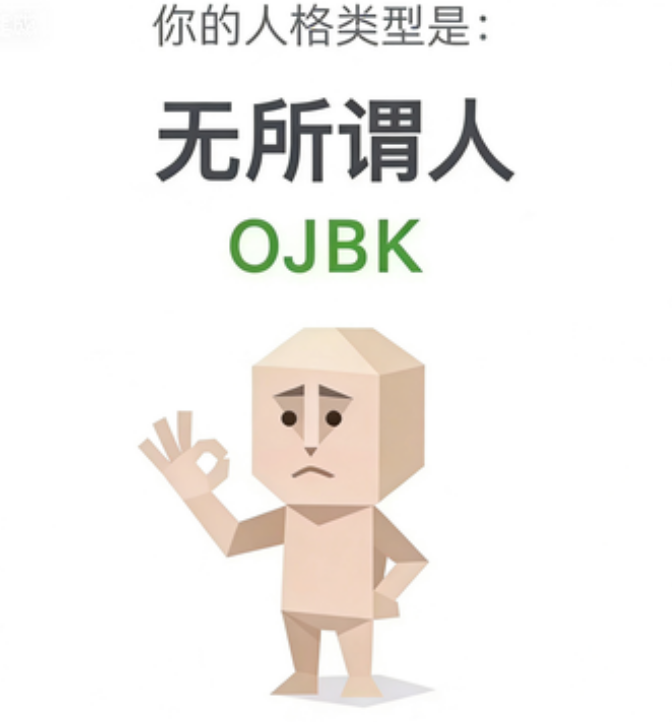
OJBK SBTI Type
You want the steering wheel even when the car is on fire.
What does OJBK mean in SBTI?
OJBK in SBTI is the ultimate "whatever" personality. The name comes from a Chinese internet slang term that roughly translates to "okay, fine, whatever" — but delivered with a specific tone of resigned acceptance. In the SBTI framework, OJBK emerges as the type that has made peace with chaos, or perhaps simply stopped fighting it.
The OJBK type got its designation because the result caption reads like a shrug: "Sure, that works. Or not. Doesn't really matter." It captures the energy of someone who has learned that flowing with circumstances is easier than trying to control them.
Unlike other SBTI types that are defined by what they do, OJBK is defined by what they don't do — they don't resist, they don't stress, and they don't pretend to have strong preferences when they don't. This is not apathy. It is a calibrated response to a world that exceeds anyone's capacity to manage.
OJBK personality traits
Adaptability as default setting
OJBK types adjust to circumstances without friction. Plans change? Fine. Restaurant is closed? Okay. Friend cancels? Sure. They do not experience each deviation as a personal offense or a crisis.
Low conflict orientation
When disagreements arise, OJBK types default to accommodation. They would rather go along with a group decision they disagree with than spend energy arguing. This makes them easy to be around, but also easy to overlook.
Authentic indifference
Unlike people who perform nonchalance as a status signal, OJBK types are genuinely unbothered by most things others stress about. They are not trying to look cool. They are actually not invested.
Hidden resilience
Because they don't waste energy fighting reality, OJBK types often function better in chaotic situations than high-control types who freeze when things go off-script.
Selective engagement
OJBK does not mean they care about nothing. They simply reserve their caring energy for things that actually matter to them. Everything else gets the "whatever" treatment.
OJBK in relationships
In friendships, OJBK types are the low-maintenance friends. They don't demand to choose the restaurant. They don't get upset if you're late. They show up when they can, and they don't when they can't. Their friends know where they stand, which is: wherever works.
In romantic relationships, OJBK types can be frustrating for partners who want clear preferences or passionate opinions. The OJBK partner's answer to "what do you want for dinner?" is reliably "whatever you want." This can feel like a lack of engagement, even when it comes from a place of trust.
When two OJBK types date, they may never decide anything. Dinner plans get postponed indefinitely. Movie night involves scrolling for three hours and then going to sleep.
OJBK at work / school
OJBK types thrive in roles that require flexibility and response-to-demand rather than proactive planning. They are excellent at handling unexpected client requests, shifting priorities, and situations that require rapid adjustment.
In school, OJBK types are the group members who accept whatever task nobody else wants. They do the work without complaining. They also don't remind anyone about deadlines, which can be problematic for the group.
The career risk for OJBK types is being overlooked. Because they don't advocate for themselves, push for recognition, or insert themselves into decision-making, they may be passed over for promotions even when their performance is strong.
OJBK under stress
When stressed, OJBK types do not typically become more controlling. They withdraw. The "whatever" energy shifts from accommodation to disengagement. They stop responding to messages. They show up but aren't really there.
The healthy stress response for OJBK types is to communicate that they are at capacity rather than disappearing. Their friends and partners usually prefer "I'm overwhelmed" to silence.
OJBK vs MBTI types
OJBK does not map cleanly to a single MBTI type, but there are patterns:
- ISFP: Similar go-with-the-flow energy, artistic rather than passive.
- INFP: Shared adaptability, but INFPs have stronger internal values that motivate them.
- ISTP: The "it is what it is" energy, but more hands-on.
- ENFP: Can test as OJBK during phases of life when they are avoiding commitment.
- INTJ: Surprising OJBK candidates when they decide that most things aren't worth the effort of controlling.
Best & worst matches for OJBK
- BOSS (The Controller): BOSS needs someone who won't fight them for control. OJBK is happy to let someone else decide. It's a functional match.
- THAN-K (The Grateful One): THAN-K appreciates OJBK's lack of demands. Both are low-conflict types.
- GOGO (The Walker): GOGO leads, OJBK follows without friction. It works.
Shareable OJBK result captions
- FAKE (The Fake): FAKE performs emotion. OJBK doesn't perform anything. FAKE finds OJBK boring. OJBK finds FAKE exhausting.
- IMSB (The Mood Swings): IMSB needs emotional engagement. OJBK's neutrality can feel like indifference.
- MONK (The Deep Thinker): MONK wants depth and philosophical engagement. OJBK is fine with shallowness. They live on different planes.
FAQ
No type is bad. BOSS is one of the most socially functional types. The label pokes fun at control tendencies, not condemns them.
ENTJ and ESTJ are the most common, but any type can get BOSS depending on their answers to the fifteen dimensions.
SBTI results reflect momentary patterns. A stressed BOSS might test as DEAD or IMFW during a difficult period.
It sounds impressive while also being self-deprecating. People love labels that let them brag and roast themselves at the same time.
Take the SBTI test
Want to find your own SBTI type? Take the free 31-question test and discover which of the 27 chaos personality types matches you.
Take the SBTI test