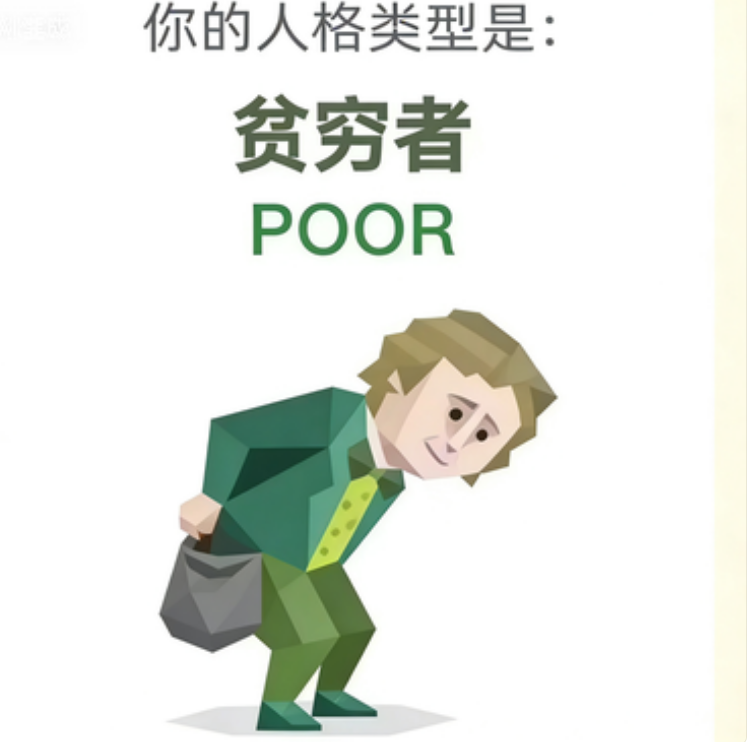
POOR SBTI Type
You want the steering wheel even when the car is on fire.
What does POOR mean in SBTI?
POOR in SBTI has nothing to do with actual financial status. It is a chaos personality label that describes someone who operates from a mindset of scarcity — not just with money, but with time, energy, emotional bandwidth, and optimism. The POOR type got its name because the result caption reads like a complaint: "I have nothing, and even if I had something, I would probably lose it."
In the SBTI framework, POOR emerges from a specific combination across fifteen dimensions that cluster around pessimism, risk aversion, and a defensive approach to life. It is not a clinical diagnosis or a socioeconomic indicator. It is a meme-ready label for people who have learned to expect the worst and are rarely disappointed.
The POOR type resonates because almost everyone has experienced periods where they felt tapped out — broke, exhausted, and running on fumes. What makes POOR a distinct personality type is that this mindset becomes their baseline rather than a temporary state.
POOR personality traits
Scarcity mindset as default
POOR types operate as if resources are always about to run out. They save things "just in case." They hesitate to spend money even when they have it. They ration their energy like they are preparing for a siege that never ends.
Defensive pessimism
POOR types brace for impact before anything happens. They assume plans will fall through. They expect the worst-case scenario. This is not negativity — it is a protective strategy. If they expect the worst, they can never be caught off guard.
Risk aversion
POOR types avoid taking chances. They prefer predictable bad outcomes to uncertain good ones. A guaranteed loss feels safer than a gamble that might pay off but might not.
Self-deprecation as humor
POOR types are often funny, but their humor is directed inward. They make themselves the butt of the joke. It is a defense mechanism — if they mock their own situation first, nobody else can hurt them with it.
Hidden generosity
Despite their scarcity mindset, POOR types can be incredibly generous when they see someone else struggling. They know what it feels like to have nothing, and they will share what little they have.
POOR in relationships
In friendships, POOR types are the ones who worry they are not contributing enough. They apologize for being broke. They feel guilty when friends pay for them. Their friends usually don't care about the money — they just want POOR to show up.
In romantic relationships, POOR types can struggle with feelings of inadequacy. They may feel they cannot provide the experiences or lifestyle their partner deserves. This insecurity can create distance even when the partner does not care about material things.
When two POOR types date, they may reinforce each other's scarcity mindset. They stay in instead of going out because they are "saving money." They miss opportunities to connect because they are afraid to spend.
POOR at work / school
POOR types at work are reliable but cautious. They don't push for promotions because they are afraid of failing. They don't ask for raises because they don't want to be told no. They stay in roles that are too small for them because safe feels better than ambitious.
In school, POOR types are the students who don't apply to reach schools even if they have the grades. They assume they won't get in, so why bother trying. They limit their own potential to avoid disappointment.
The career risk for POOR types is self-sabotage through playing it too safe. They settle for less than they are capable of because they have convinced themselves they don't deserve more.
POOR under stress
When stressed, POOR types retreat into scarcity mode. They cut every possible expense. They stop socializing because "it costs money." They work harder but feel poorer because they are running on empty.
The healthy stress response for POOR types is to recognize that they are in a temporary state, not a permanent condition. They need to invest in themselves — rest, connection, small joys — even when it feels reckless to do so.
POOR vs MBTI types
POOR does not map cleanly to a single MBTI type, but there are patterns:
- ISFJ: Similar protective energy, but ISFJs express it through care for others rather than self-limitation.
- INFJ: Shared tendency to anticipate problems, but INFJs are more visionary.
- ISTJ: Cautious and conservative, but ISTJs find security in structure rather than scarcity.
- INFP: Can test as POOR during periods of low confidence or financial stress.
- ISTP: Pragmatic and resourceful, but ISTPs are more adaptable than POOR types.
Best & worst matches for POOR
- THAN-K (The Grateful One): THAN-K helps POOR see abundance instead of scarcity. They model a different relationship with resources.
- RICH (if this type exists): The complement to POOR — RICH models abundance and possibility.
- GOGO (The Walker): GOGO models action over rumination. POOR thinks; GOGO moves.
Shareable POOR result captions
- BOSS (The Controller): BOSS wants to scale and grow. POOR wants to play it safe. They have fundamentally different approaches to risk.
- FAKE (The Fake): FAKE performs wealth and success. POOR sees through it and resents the performance.
- OJBK (The Whatever Person): OJBK's nonchalance about everything, including money, triggers POOR's scarcity anxiety.
FAQ
No type is bad. BOSS is one of the most socially functional types. The label pokes fun at control tendencies, not condemns them.
ENTJ and ESTJ are the most common, but any type can get BOSS depending on their answers to the fifteen dimensions.
SBTI results reflect momentary patterns. A stressed BOSS might test as DEAD or IMFW during a difficult period.
It sounds impressive while also being self-deprecating. People love labels that let them brag and roast themselves at the same time.
Take the SBTI test
Want to find your own SBTI type? Take the free 31-question test and discover which of the 27 chaos personality types matches you.
Take the SBTI test