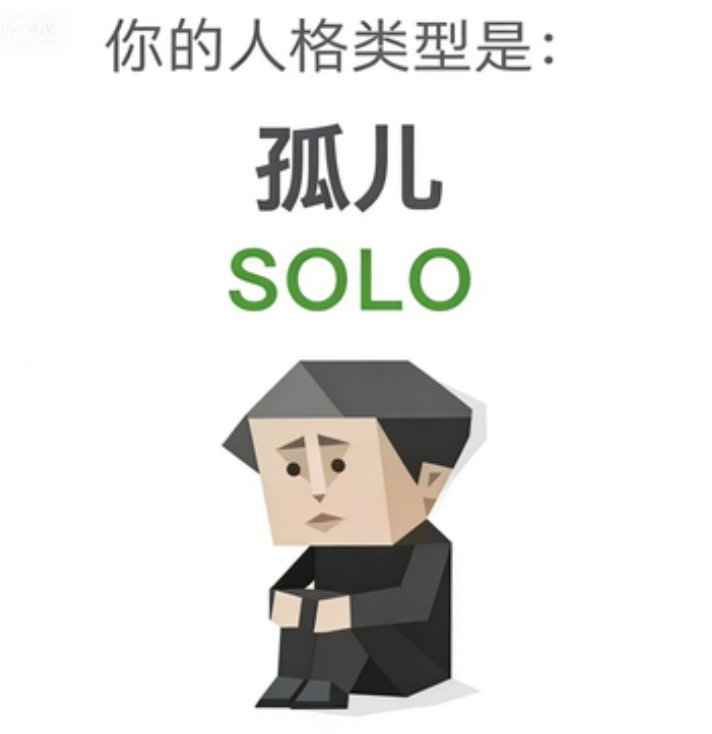
SOLO SBTI Type
You want the steering wheel even when the car is on fire.
What does SOLO mean in SBTI?
SOLO in SBTI is not about being antisocial or lonely. It is a chaos personality label for the person who genuinely prefers their own company, who finds group dynamics exhausting by default, and who treats solitude as a need rather than a circumstance. The SOLO result caption reads something like: "I am not avoiding you. I am returning to my natural habitat."
In the SBTI framework, SOLO emerges from high scores on introversion, independence, and low social dependency. It describes the social archetype who leaves parties early not because they are sad but because they have had enough, who keeps a small circle by choice, and who finds "let's catch up" texts mildly stressful.
SOLO is not the same as being shy. Many SOLO types are socially skilled and charming in short bursts. The difference is that social interaction costs them energy rather than providing it. They are not bad at people. They are done with people sooner.
The SOLO type is often misunderstood as cold or unfriendly. In reality, SOLO types can be deeply loyal friends and loving partners. They just need more recovery time than other types.
SOLO personality traits
Solitude as restoration
SOLO types do not just tolerate alone time. They require it. A weekend without social plans is not a void to fill. It is the reset they need to function. Their ideal vacation involves no one else.
Selective social investment
SOLO types keep their circle small and their standards high. They do not collect acquaintances. They curate relationships. A SOLO type with three close friends is more socially satisfied than an extrovert with fifty casual contacts.
Independence as identity
SOLO types define themselves by self-sufficiency. They do not wait for permission, validation, or company to do things. They go to movies alone, eat at restaurants alone, and travel alone without it feeling like a compromise.
Social battery management
SOLO types are acutely aware of their social energy levels. They know when they are at twenty percent and need to exit. They are not rude when they leave early. They are preventing a crash.
Deep focus preference
SOLO types excel at activities that require sustained attention without interruption. They are the readers, the solo gamers, the long-distance runners, the people who can work on a project for eight hours without checking their phone.
SOLO in relationships
In friendships, SOLO types are low-maintenance but high-quality friends. They do not need daily check-ins. They do not get offended if you do not text back immediately. When they show up, they are fully present. When they need space, they disappear without drama.
In romantic relationships, SOLO types need partners who understand that "I need to be alone" is not code for "I do not love you." The right partner respects their solitude. The wrong partner takes it personally.
When two SOLO types date, the relationship is either a beautiful rhythm of togetherness and space or a competition over who needs more alone time. Communication is essential because both assume the other wants what they want.
SOLO at work / school
SOLO types thrive in roles that reward independent work, deep focus, and minimal meetings. Remote work was invented for SOLO types. Programming, writing, research, design, and any role with clear individual accountability suits them.
In school, SOLO types are often the students who prefer solo projects to group work. They are not bad teammates; they are just better alone. They may be underestimated in collaborative environments because their contributions are quiet rather than performative.
The career risk for SOLO types is being overlooked in workplaces that reward visibility over output. They need environments where deep work is valued and social performance is not required for advancement.
SOLO under stress
When stressed, SOLO types retreat further into solitude. They cancel plans, mute notifications, and create a bubble of isolation that helps them process. This is healthy if temporary. It becomes unhealthy when the retreat extends indefinitely.
Recovery requires gentle re-entry: a walk with one trusted person, a low-stakes social activity, or a creative project that connects them to others without demanding performance.
SOLO vs MBTI types
- INTJ: Natural overlap. Strategic, independent, low social needs.
- INTP: Similar solitude preference, more theoretical than action-oriented.
- ISTJ: Quiet competence, values routine over novelty.
- INFP: Rich inner world, selective about who enters it.
- ISTP: Tactical independence, prefers doing to discussing.
Best & worst matches for SOLO
- MONK (The Monk): MONK understands inner life. Neither demands constant contact.
- OJBK (The "Whatever" Person): OJBK does not take SOLO's withdrawal personally.
- DEAD (The Dead Inside): DEAD and SOLO can coexist in comfortable silence.
Shareable SOLO result captions
- BOSS (The Main-Character Manager): BOSS wants to organize SOLO's social life. SOLO wants BOSS to stop.
- DRUNK (The Drunk): DRUNK needs constant social energy. SOLO does not have it to give.
- GOGO (The Walker): GOGO wants to do things together. SOLO wants to do things alone.
FAQ
No type is bad. BOSS is one of the most socially functional types. The label pokes fun at control tendencies, not condemns them.
ENTJ and ESTJ are the most common, but any type can get BOSS depending on their answers to the fifteen dimensions.
SBTI results reflect momentary patterns. A stressed BOSS might test as DEAD or IMFW during a difficult period.
It sounds impressive while also being self-deprecating. People love labels that let them brag and roast themselves at the same time.
Take the SBTI test
Want to find your own SBTI type? Take the free 31-question test and discover which of the 27 chaos personality types matches you.
Take the SBTI test