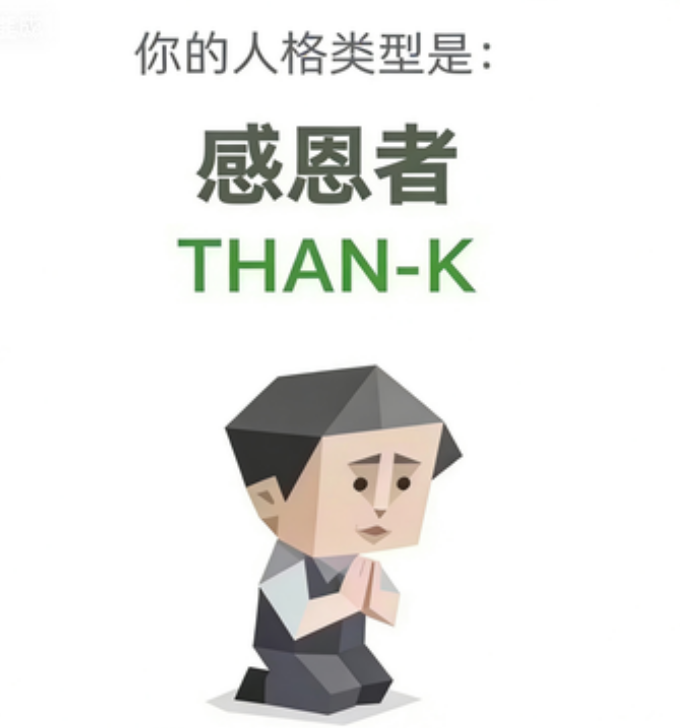
THAN-K SBTI Type
You want the steering wheel even when the car is on fire.
What does THAN-K mean in SBTI?
THAN-K in SBTI is the gratitude personality — the person who approaches life from a baseline of appreciation, finding reasons to be thankful even in difficult circumstances. The name is a playful spelling of "thank," emphasizing that gratitude is not just something they feel, but who they are. In the SBTI framework, THAN-K emerges as the type that defaults to noticing what is right rather than what is wrong.
The THAN-K type got its designation because the result caption reads like someone who is perpetually grateful: "I'm just glad to be here, honestly." It captures the energy of people who send thank-you notes for routine favors, who appreciate small gestures, who seem to have an infinite capacity to find silver linings.
Unlike other SBTI types that are defined by cynicism, ambition, or defensiveness, THAN-K is defined by appreciation. This is not toxic positivity — they are not pretending everything is perfect. They are simply choosing to focus on what is good.
THAN-K personality traits
Gratitude as default setting
THAN-K types naturally notice what they have rather than what they lack. They appreciate good service. They value thoughtful gestures. They feel lucky to be alive, to have friends, to have opportunities that others might take for granted.
Appreciation of small things
THAN-K types find joy in details others overlook. A perfect cup of coffee. A stranger holding the door. A sunset. Their happiness comes from accumulated small appreciations rather than grand achievements.
Resistance to entitlement
THAN-K types don't feel owed anything. They are surprised by good fortune rather than expecting it. They don't take people for granted. They recognize that everything they have could be different, and this awareness keeps them humble.
Emotional generosity
THAN-K types are quick to express appreciation. They say thank you. They acknowledge others' contributions. They make people feel seen and valued. This makes them deeply likable, even if their constant positivity can occasionally feel exhausting to more cynical types.
Resilience through reframing
THAN-K types cope with difficulty by finding things to be grateful for even within the struggle. This is not denial — it is a survival strategy. They acknowledge pain while also noticing beauty, connection, or learning that comes with it.
THAN-K in relationships
In friendships, THAN-K types are the ones who make their friends feel valued. They remember to say thank you. They appreciate small things their friends do. They are reliable, supportive, and genuinely happy for others' successes. Their friends know they are cherished.
In romantic relationships, THAN-K types are appreciative partners. They don't take their partners for granted. They express gratitude for both big and small things. This can create very positive relationships, but there is a risk: THAN-K types may tolerate poor treatment because they are so focused on what is good that they minimize what is bad.
When two THAN-K types date, they create a mutual appreciation society. They constantly thank each other. They focus on the best in each other. It can be intensely positive, almost to the point of lacking necessary conflict or critical feedback.
THAN-K at work / school
THAN-K types at work are the employees who appreciate their opportunities. They don't complain about routine tasks. They thank their colleagues for help. They are easy to work with because they are not demanding or entitled. Managers appreciate their positive attitude, even if sometimes they are taken advantage of because they don't advocate for themselves.
In school, THAN-K types are the students who thank teachers after class. They appreciate learning opportunities. They are grateful to their classmates for collaboration. They may not be the most ambitious students, but they are among the happiest.
The career risk for THAN-K types is exploitation. Because they are so appreciative of whatever they get, they may accept less than they deserve — lower pay, fewer promotions, worse treatment — because they are focused on being grateful for having anything at all.
THAN-K under stress
When stressed, THAN-K types double down on gratitude. They look for things to appreciate even as things are falling apart. This can be a strength — it helps them maintain perspective — but it can also become a way to avoid addressing real problems. Gratitude should not mean accepting mistreatment.
The healthy stress response for THAN-K types is to recognize that sometimes feeling upset is appropriate. Not every situation has a silver lining. Sometimes things are just bad, and that's okay.
THAN-K vs MBTI types
THAN-K does not map cleanly to a single MBTI type, but there are patterns:
- ENFJ: Natural warmth and appreciation, but ENFJs are more active and leadership-oriented.
- ESFJ: Similar appreciation focus, but ESFJs are more traditional and rule-following.
- INFP: Shared capacity for finding meaning and beauty, but INFPs are more melancholic.
- INFJ: Can test as THAN-K when they are in phases of spiritual gratitude practice.
- ISFJ: Gentle and appreciative, but ISFJs are more focused on caring for others than expressing thanks.
Best & worst matches for THAN-K
- ATM-er (The Giver): ATM-er needs appreciation. THAN-K provides it in abundance. It's a mutually reinforcing dynamic.
- OJBK (The Whatever Person): OJBK's low-drama style balances THAN-K's enthusiasm. They understand each other.
- BOSS (The Controller): BOSS needs validation. THAN-K provides it without playing games. It works.
Shareable THAN-K result captions
- FUCK (The Frustrated One): FUCK finds THAN-K's constant positivity exhausting and inauthentic. THAN-K finds FUCK's negativity draining.
- DEAD (The Dead Inside): DEAD has checked out. THAN-K tries to find gratitude in DEAD's detachment, but it doesn't connect.
- POOR (The Scarcity Mindset): POOR sees lack everywhere. THAN-K sees abundance. They have fundamentally different orientations.
FAQ
No type is bad. BOSS is one of the most socially functional types. The label pokes fun at control tendencies, not condemns them.
ENTJ and ESTJ are the most common, but any type can get BOSS depending on their answers to the fifteen dimensions.
SBTI results reflect momentary patterns. A stressed BOSS might test as DEAD or IMFW during a difficult period.
It sounds impressive while also being self-deprecating. People love labels that let them brag and roast themselves at the same time.
Take the SBTI test
Want to find your own SBTI type? Take the free 31-question test and discover which of the 27 chaos personality types matches you.
Take the SBTI test