THIN-K SBTI Type
You want the steering wheel even when the car is on fire.
What does THIN-K mean in SBTI?
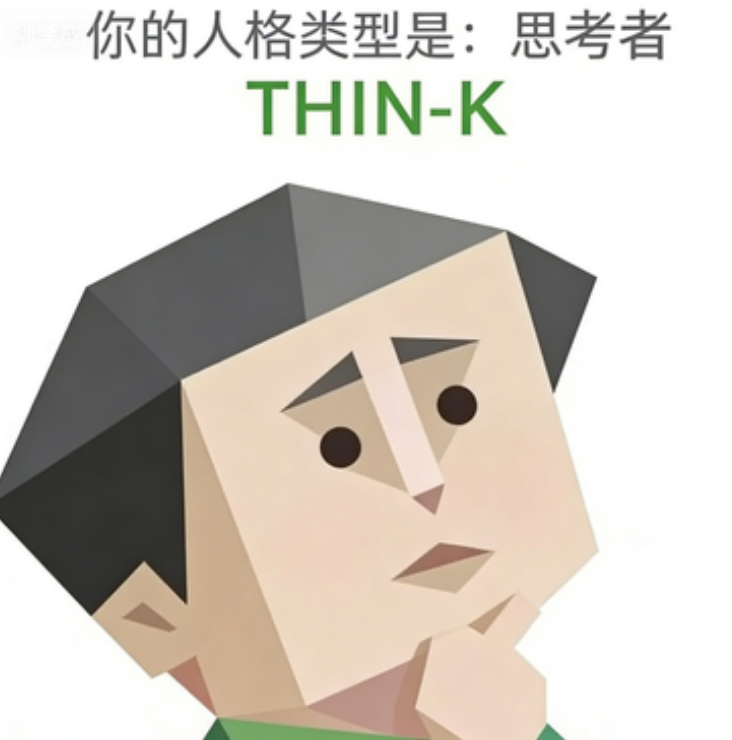
THIN-K in SBTI is the "Overthinker" type. It is a chaos personality label for the person who cannot stop analyzing, who sees seventeen angles to every decision, and who treats a simple text message like a cryptography exercise. The THIN-K result caption reads something like: "I have thought about this from every angle. I am now paralyzed by information."
In the SBTI framework, THIN-K emerges from high scores on analytical depth, pattern recognition, and decision anxiety. It describes the social archetype who researches a restaurant for an hour before ordering, who drafts and redrafts emails for thirty minutes, and who has mentally simulated every possible outcome of a conversation before having it.
THIN-K is not the same as intelligence. Many THIN-K types are of average intelligence who simply cannot turn their brain off. The problem is not that they think too well. It is that they think too much, about everything, all the time.
The THIN-K type is often funny to others because their internal process is so elaborate for such small stakes. They are the friend who creates a spreadsheet to decide which movie to watch.
THIN-K personality traits
Analysis as default mode
THIN-K types do not just observe. They dissect. A casual comment becomes a puzzle to solve. A minor decision becomes a research project. Their brain does not have an off switch for evaluation.
Pattern recognition run amok
THIN-K types see connections everywhere. They notice that three people wore blue today and wonder if it means something. They remember what you said six months ago and connect it to what you said today. Sometimes they are right. Often they are just tired.
Decision paralysis
The more a THIN-K type thinks about a decision, the harder it becomes. Every option has pros and cons. Every pro has a hidden con. Every con has a mitigating factor. They can research a purchase until the sale ends.
Mental simulation as rehearsal
Before any social interaction, THIN-K types have already played out the conversation in their head. They have scripted their opening line, predicted your response, and prepared three follow-ups. The real conversation rarely follows the script.
Exhaustion from their own brain
The defining suffering of the THIN-K type is not external stress. It is the fatigue of a mind that will not rest. They go to bed thinking. They wake up thinking. There is no escape from their own analysis.
THIN-K in relationships
In friendships, THIN-K types are the advisors. They will analyze your relationship problem from twelve perspectives, identify patterns you missed, and offer a nuanced take that is probably correct. They are also the friend who takes three days to decide where to meet for coffee.
In romantic relationships, THIN-K types are thoughtful but occasionally exhausting partners. They remember everything, which is nice. They analyze everything, which is less nice. Their partner may feel like every conversation is being processed for hidden meaning.
When two THIN-K types date, the relationship is either an intellectual paradise or a paralysis spiral. They understand each other's need to analyze but may never actually make decisions together.
THIN-K at work / school
THIN-K types excel in roles that reward deep analysis, strategic thinking, and pattern detection. Research, data science, law, consulting, and any role where "it depends" is the correct answer suits them.
In school, THIN-K types are often the students who write longer essays than required because they saw too many relevant angles. They may overprepare for exams because they cannot predict which details matter.
The career risk for THIN-K types is analysis paralysis in fast-moving environments. They need roles where depth is valued and speed is secondary, or teams that can balance their deliberation with decisive action.
THIN-K under stress
When stressed, THIN-K types think harder. They analyze the stress, categorize it, and create mental frameworks for understanding it. This is sometimes helpful and often just a way of avoiding action. They would rather understand a problem than solve it.
Recovery requires external deadlines, physical activity that demands full attention, or conversations with people who make decisions quickly and confidently.
THIN-K vs MBTI types
- INTP: Natural overlap. Analytical, theoretical, loves systems and frameworks.
- INTJ: Strategic overthinking, more focused on outcomes than pure analysis.
- INFJ: Analytical about people, reads between lines constantly.
- ISTJ: Practical overthinking, worries about details and procedures.
- ENTP: Analytical but decisive, uses thinking as a tool rather than a trap.
Best & worst matches for THIN-K
- GOGO (The Walker): GOGO's decisiveness balances THIN-K's paralysis. GOGO starts walking; THIN-K brings the map.
- OJBK (The "Whatever" Person): OJBK makes decisions without angst, which THIN-K finds both enviable and relieving.
- BOSS (The Main-Character Manager): BOSS decides. THIN-K analyzes. In the right balance, this works.
Shareable THIN-K result captions
- OH-NO (The Worrier): Two anxiety-driven types create a feedback loop of worst-case scenarios.
- CTRL (The Controller): CTRL wants to plan. THIN-K wants to analyze the plan. Nothing gets done.
- FAKE (The Fake): THIN-K's constant analysis detects FAKE's inconsistencies, creating mutual discomfort.
FAQ
No type is bad. BOSS is one of the most socially functional types. The label pokes fun at control tendencies, not condemns them.
ENTJ and ESTJ are the most common, but any type can get BOSS depending on their answers to the fifteen dimensions.
SBTI results reflect momentary patterns. A stressed BOSS might test as DEAD or IMFW during a difficult period.
It sounds impressive while also being self-deprecating. People love labels that let them brag and roast themselves at the same time.
Take the SBTI test
Want to find your own SBTI type? Take the free 31-question test and discover which of the 27 chaos personality types matches you.
Take the SBTI test